
Vichie81/Adobe Stock
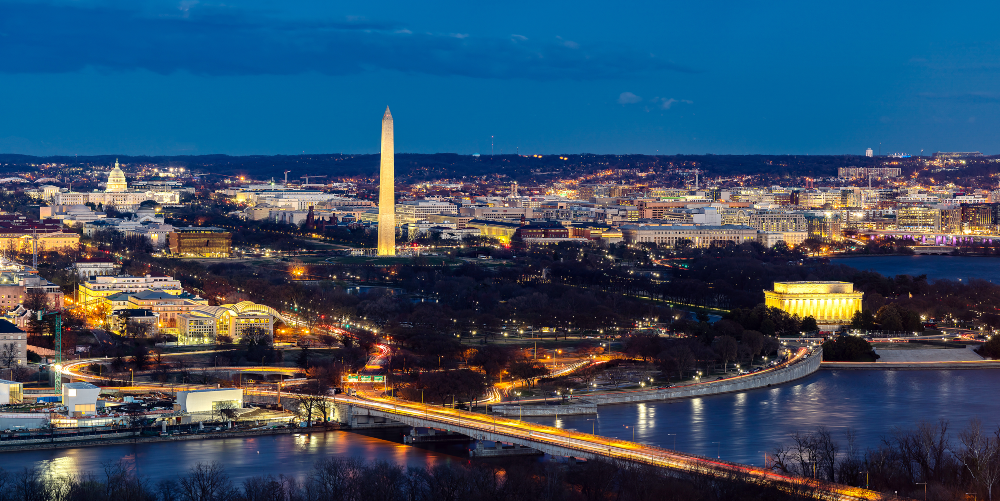
The capitol region of Washington, D.C. glows at twilight.
Washington, D.C.
Ande Flagg
Editors Note: Multiple military installations dot the landscape in and around Washington, D.C. While Ande doesn’t mention a specific installation in her article, these adventures are feasible for those stationed anywhere in Washington, D.C. or parts of Maryland and Virginia.
My husband moved from northern Indiana to “Northern” Virginia (the area outside of Washington, D.C.) when he was in the sixth grade. His memories from his middle school and high school years don’t include a lot of exploring the D.C. area.
In fact, he said, “I thought there was nothing to do.”
That’s right. Seventeen-year-old Tim thought that living in the D.C. area was boring.
Fast forward 20 years. We moved to Washington state for Tim to work at Joint Base Lewis McChord (JBLM). After arriving he would be awaiting his company command for about two years. He knew he might be tasked with a deployment during that time. Just three months after finishing in-processing we found out that he would be deploying…
...to Crystal City, Virginia just across the river from Washington, D.C....
his middle school and high school home…
...for a sixth-month “deployment.”
Seriously.
I didn’t use the wrong word. This wasn’t considered a TDY. For whatever reason, this would be a “deployment.” Unaccompanied and paid like a deployment. So weird, yes.
Roll with It
What to do? We already had commitments for the summer and school year in Washington state. We couldn’t get out of our rental agreement.
We decided to finish the school year separated – the boys and me in Washington State and Tim in Virginia. Then the boys and I flew to Virginia and spent a month with Tim in the summer, while also visiting family and exploring Washington, D.C.
At this point our parents lived about 90 minutes from each other. Tim’s mom was only 20 minutes from his Crystal City apartment.
Ande Flagg/PCS Adventures
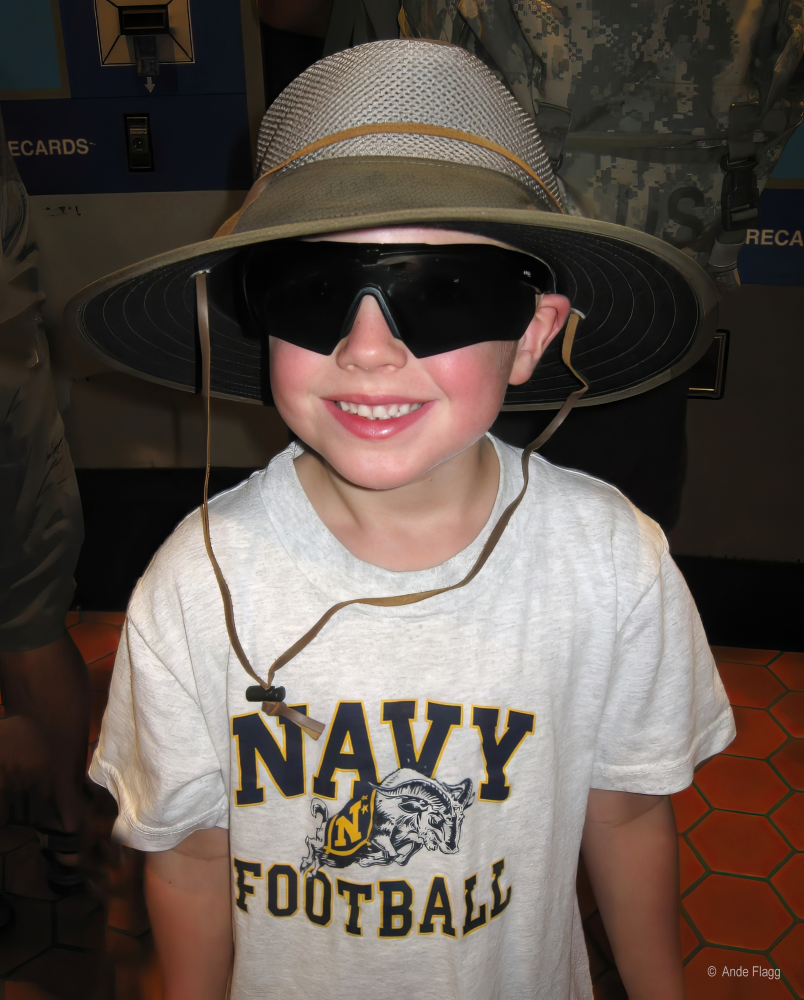
Boy 2 gears up and is ready for adventure!
Fortunately, we had a lot of time with Tim on the weekends during our month together. Plus, he had a few days of additional vacation around the Fourth of July, so he spent time exploring with us.
Whether or not he was available, if the boys and I weren’t with our extended family, we were exploring D.C.
Hitting the Highlights
The following is a “highlight reel” of where we visited that summer.
The various war memorials on the National Mall
It was a sweltering day, but we brought a picnic and two boys who we knew needed to find space to run. Where better to run around in the D.C. area than the National Mall and Memorial Parks? It was a great open-air space with so many monuments! There was a feast for the eyes in every direction. We spent as much or as little time at each memorial as we wanted.
I remember visiting the Vietnam War Memorial with my dad as a child. He flew in Vietnam and knew a few of the people whose names were listed as “Killed in Action” on the wall.
Ande Flagg/PSC Adventures
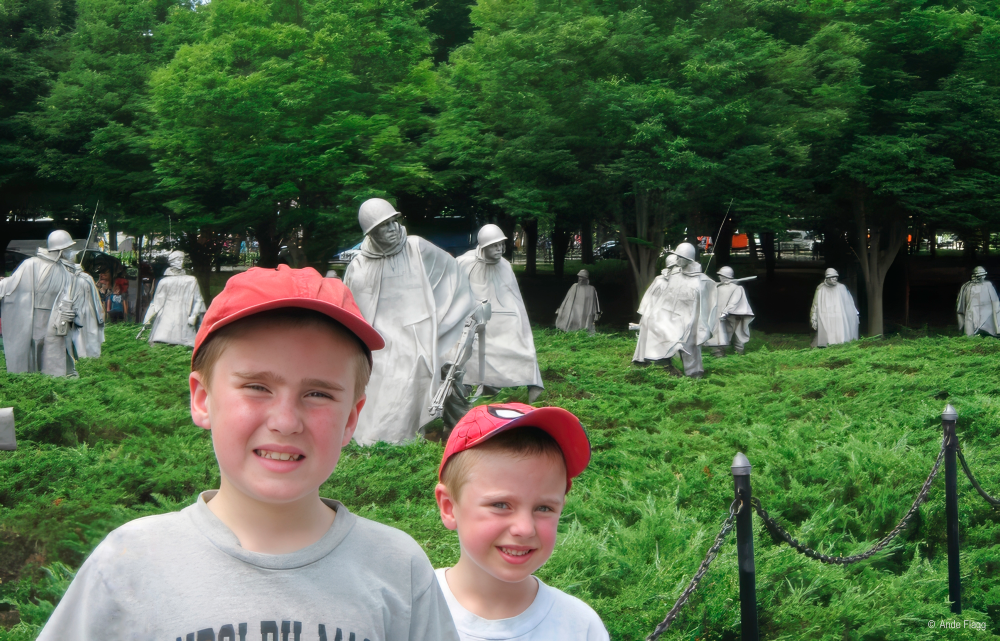
The boys explore the Korean War Veterans Monument.
When I went back with our family, we were able to discuss the thousands of names that belonged to men who were willing to pay the ultimate price and that, furthermore, their grandfather knew some of these heroes. It made an impression.
The Korean War Memorial was my favorite. With the life-sized soldiers seeming to be on patrol for eternity, I saw a ”lostness” in their eyes. Whether by design or by divine inclination, staring into the vacant eyes of the Korean War soldiers of this monument called me to the place where they stand forever.
Denise Sloan/PSC Adventures
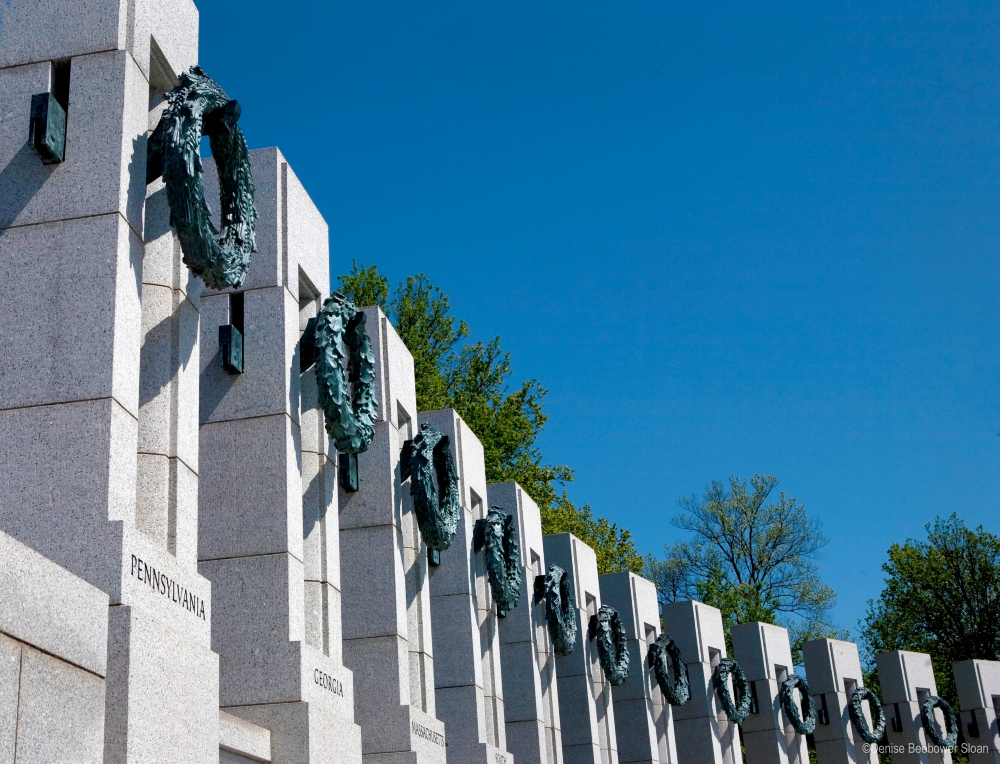
All states and US territories appear at the World War II Memorial.
We picnicked near the World War II monument which was vast by comparison to the other monuments and the most recently constructed in 2004. It had pillars around a large fountain and pool. Each pillar bore a state’s name on it as a witness to its citizens who sacrificed and united in the Allied cause. The Atlantic and Pacific theaters are both represented by the large pavilions on either side of the fountain. The boys had been reading some books about WWII on our trip, so our visit to the monument served as a bit of a capstone for some of our homeschool work.
The presidential monuments on the Mall
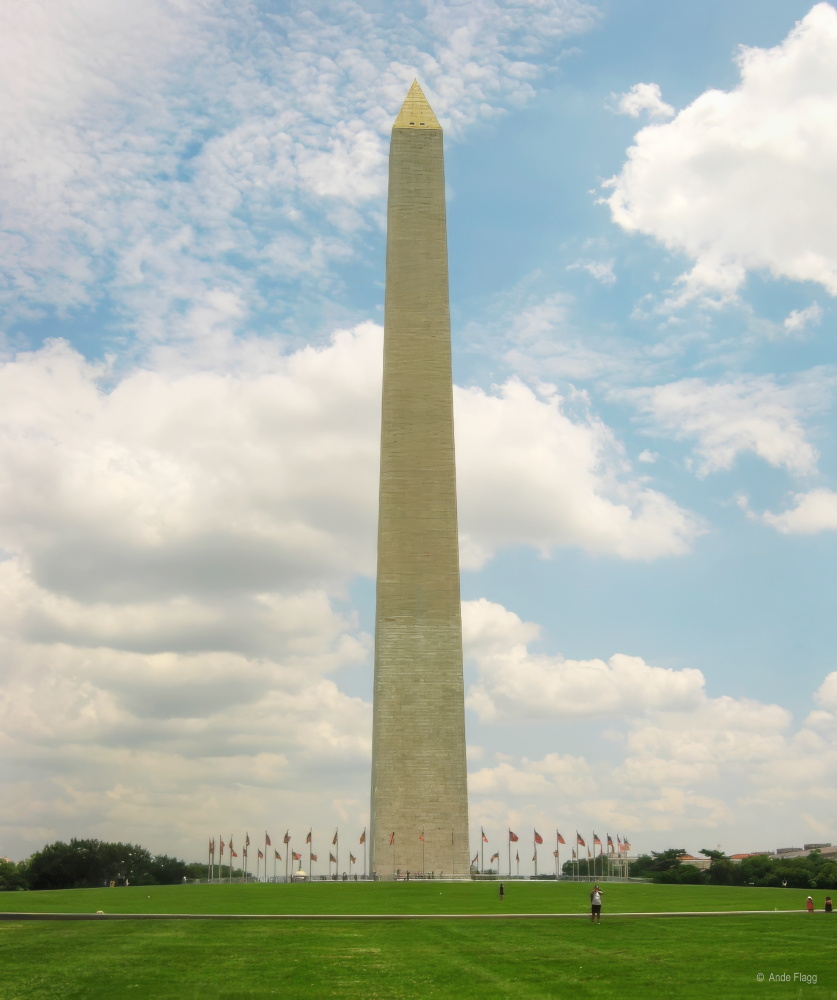
The Washington Monument was closed. So, we couldn’t enter, but it’s hard to avoid seeing the tall, white structure that reminded this Navy brat of a mast of a ship. It resides in the middle of the Mall near the Reflecting Pool, the Tidal Basin and the White House.
Interesting fact that I learned in college in ancient art history was that the design was modeled after ancient, Egyptian obelisks. Obelisks were often used to commemorate important events or people. They pointed like arrows to the sky to remind the viewer to look toward heaven.
Ande Flagg/PCS Adventures
The Washington Monument points toward heaven.
The setting of the Washington Monument in its central location and gleaming white in the sunshine very much reminded me that George Washington’s acts as Commander of the Continental Army, President of the Constitutional Convention and first President of the United States of America remained still central to the founding and functioning of our nation.
Ande Flagg/PCS Adventures
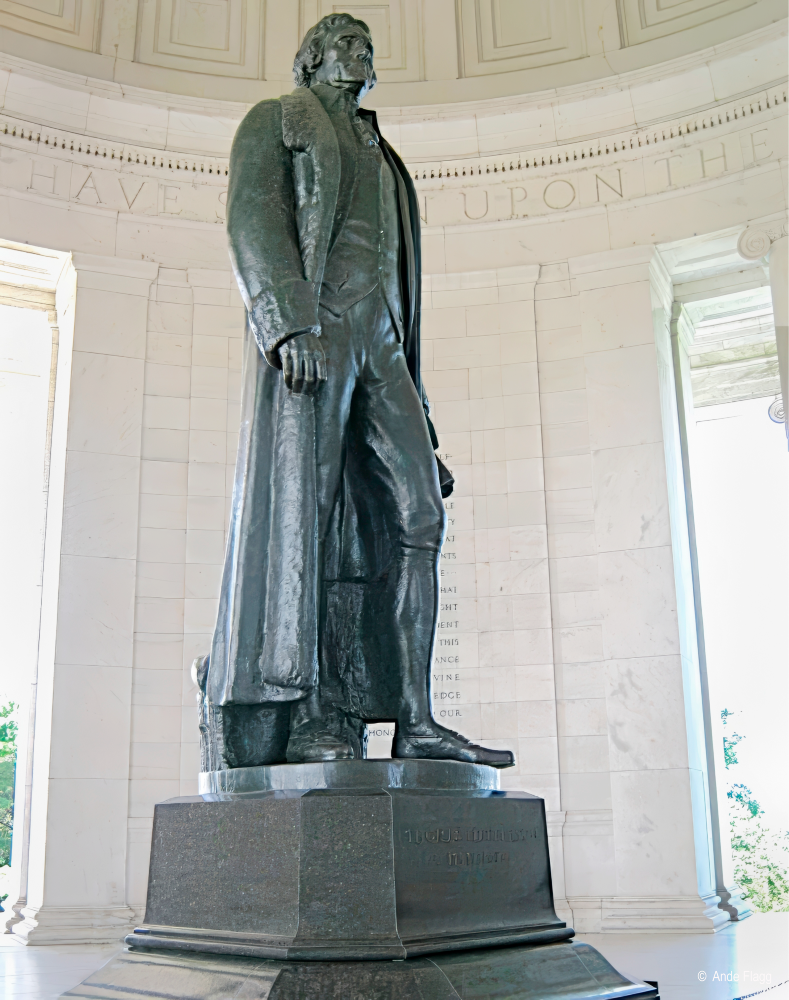
Thomas Jefferson towers over everyone in his rotunda.
The Jefferson and Lincoln memorials felt like temples. In fact, having visited Greek and Roman temples in college, these two monuments were obviously constructed to evoke the feeling of the temples of the ancients. Located on the south and west sides of the Mall respectively, these shrines helped us remember that ordinary men were “larger than life” because of the good they did for our country. While both presidents were among the tallest in our country’s history, it is their Presidential legacies that continue to draw people from around the world to visit their memorials. As I reflected, I thought, that we as a nation can better understand what makes a great leader from their two examples.
Arlington National Cemetery and The Tomb of the Unknown Soldier
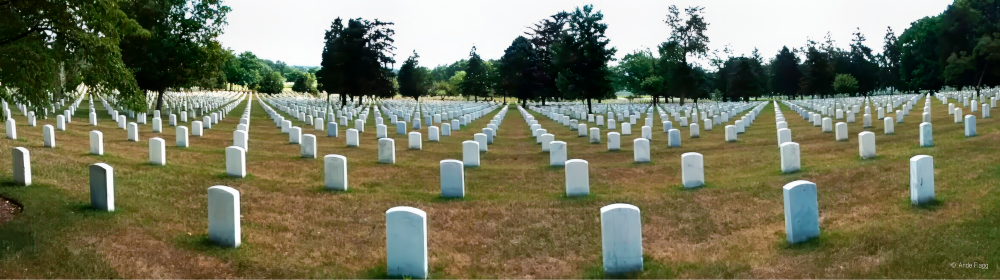
We visited Arlington National Cemetery to help our boys understand there were a vast number of men and now women who died for our country either in service or after having served. The boys were six and eight at the time. They noticed how the tidy rows of gravestones resembled soldiers in formation. We affirmed their observation and told them to think of these as soldiers lined up. It was an effective time for reflection and evoking gratitude in our young patriots.
Ande Flagg/PCS Adventures
Gravestones stretch as far as the eye can see at Arlington National Cemetery.
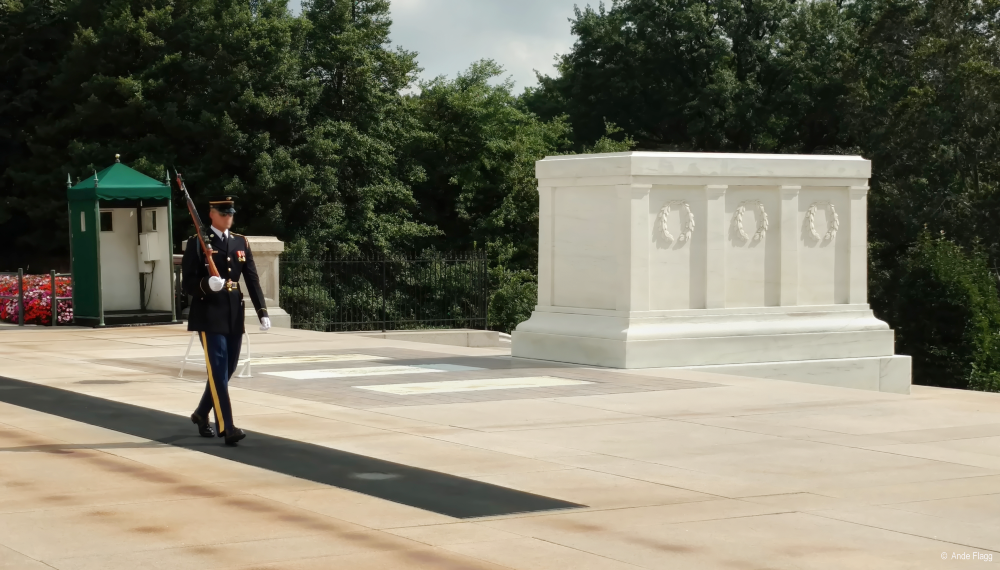
We went on to the Tomb of the Unknown Soldier to observe the changing of the guard. It was a somber occasion and another teachable moment to experience with the boys. They got to see just how serious we should take others’ sacrifices for us.
We talked about the Bible verse that seems to sum up what we were watching being honored, “Greater love has no one than this, that someone lay down his life for his friends….”
Ande Flagg/PCS Adventures
A soldier from the Old Guard patrols the Tomb of the Unknown Solider at Arlington National Cemetery.
In return for their sacrifice, a soldier, impeccably dressed, guarded the tomb, and paced in perfect time for 30 to 60 minutes until the next changing on the guard. It was an impressive and yet moving ceremony.
Another historic site on the grounds at the Arlington National Cemetery was Arlington House, also known as the Robert E. Lee Memorial. It was through Lee's wife’s line that they were able to live here. Why was that important? Because she was George Washington’s step-great-granddaughter.
Robert E. Lee married his hero’s great-granddaughter, a fact that the boys had learned earlier in the year. Again, it was fun to see some of the sites that brought history to life for the boys.
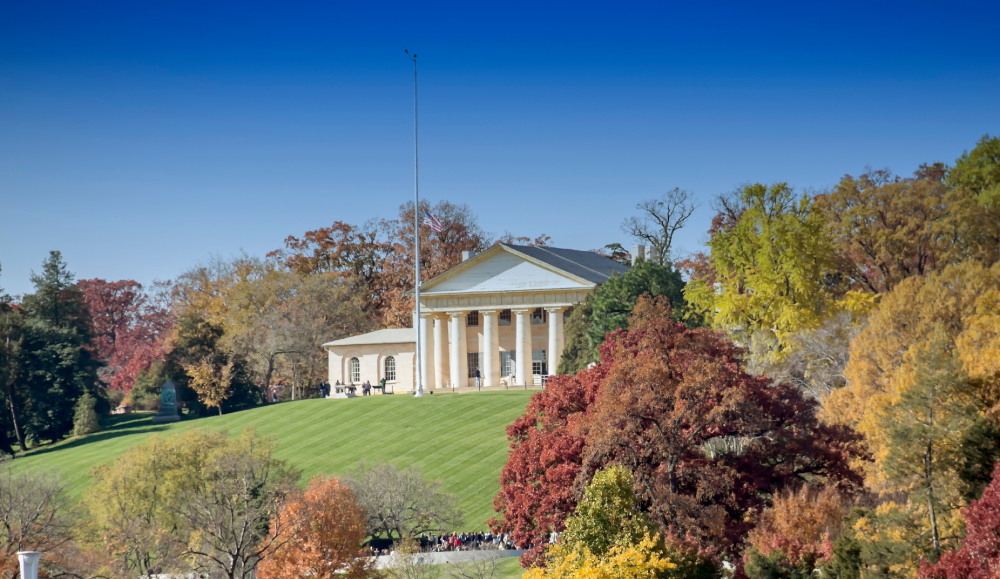
Robert E. Lee and Martha Custis married at Arlington House and lived there starting in 1857.
doganmesut/Adobe Stock
Arlington House sits high above Arlington National Cemetery.
During the Civil War, the Union captured the plantation and turned the grounds into a military cemetery. Now Arlington House, a large white, stately plantation home, served as a museum. The museum’s purpose was to recall both Robert E. Lee’s help in promoting peace during reconstruction as well as telling the stories of the slaves who lived on the plantation prior to Emancipation.
The tour of the house included a lot of artifacts from both the Washington and Custis-Lee eras of the home. Like most museums over the last eight years, the exhibits have probably rotated several times over. Still, the tour is worth it to see how “they lived.” At the end I remember walking out of the home onto the veranda. The view of the cemetery was humbling and beautiful in its own way.
The National Archives Museum and the US Navy Memorial
The train system in the DC area was truly so valuable for our month staying with Tim. We went a few places as a family before I decided to take the boys out on my own. Alas, the day we ventured out, just the three of us, the train didn’t go all the way from Crystal City to the National Archives because the Washington Metro was doing maintenance on the tracks. Fortunately, the buses that took the place of those trains were well marked and several smocked attendants at the various Metro stops helped us find our way.
Ande Flagg/PCS Adventures
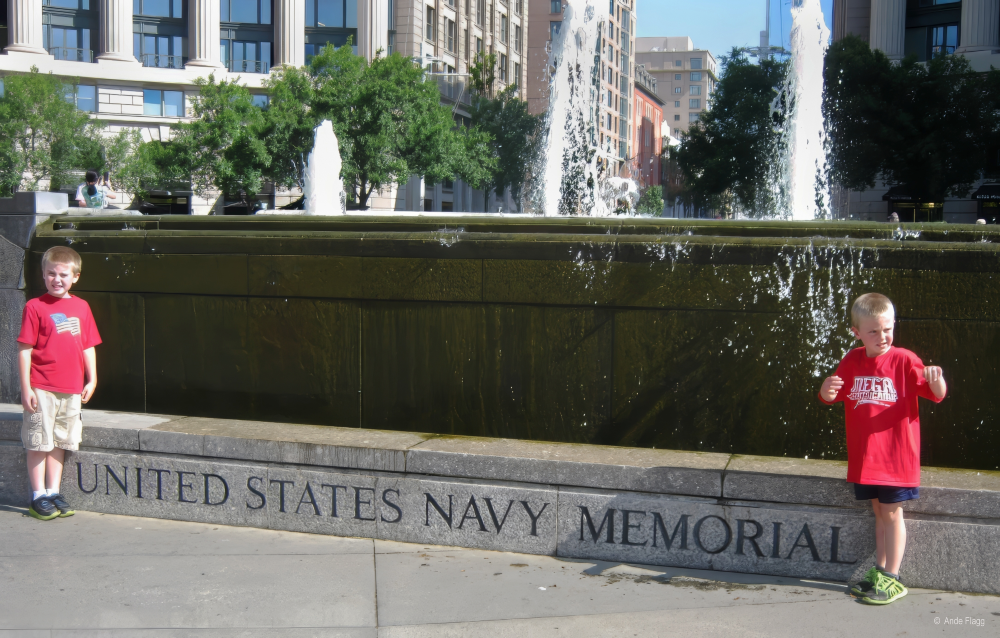
The boys explored the low fountain at the US Navy Memorial.
At the stop for the National Archives, we got off of the bus and walked across the street to find a cool surprise: the US Navy Memorial. It seemed to rise up out of the ground between two bus stops. Most people in the area paid it no mind. It had become like a park bench with a fountain in its midst– just another place to lean against while eating a hotdog.
I thought the memorial was like finding a ship in the middle of the street. We took a photo and we talked about the importance of remembering those lost at sea. Since the boys knew their grandfathers were both in the Navy, we talked about how we can honor them as well.
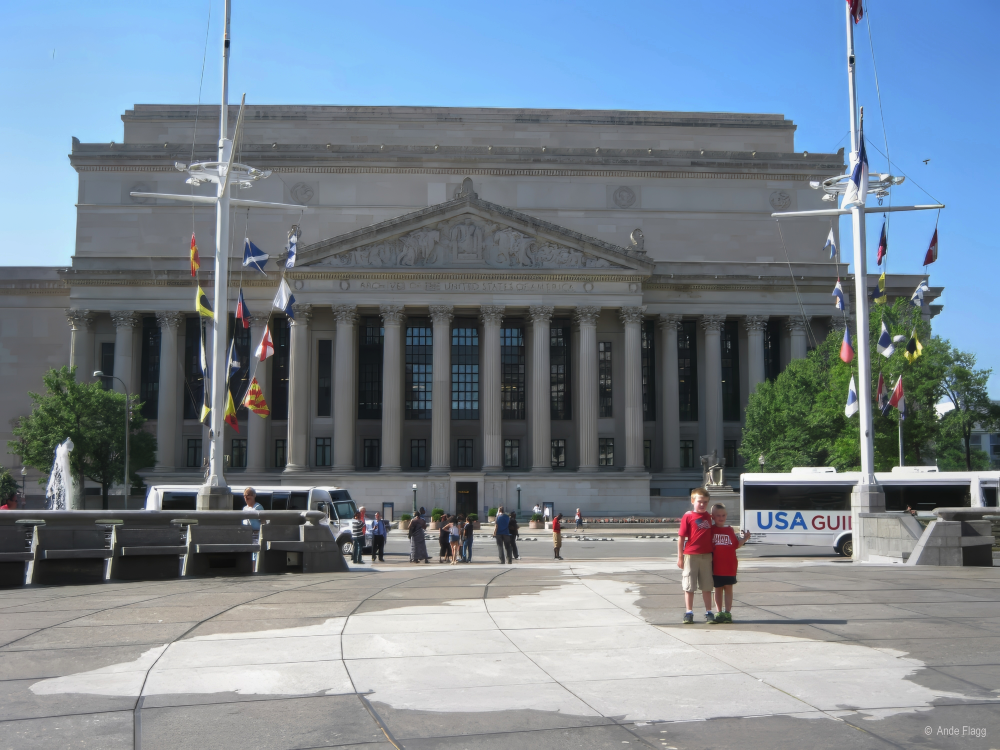
Then we headed into the National Archives Museum to see our founding documents. These documents, collectively known as The Charters of Freedom, are located in a very dim rotunda. The movie “National Treasure” depicts this very place, but it was not nearly as dark in the movie.
Ande Flagg/PCS Adventures
The boys pose at the US Navy Memorial with the National Archives in the background.
The cue to see the documents was limited so that only a few people were permitted in the viewing area at a time. The line moved along at an adequate pace for observing documents with archaic script. The atmosphere was almost solemn in the rotunda, like going to a viewing of a beloved family member. Perhaps it is the seriousness with which we should take our freedoms that prompted such an air.
Once we saw the original documents and, of course, talked about their significance (because homeschool mom) we continued on to see more of the exhibits in the museum. There is only one other permanent exhibit at the Archives called “The Record of Rights”.
It started with the 1297 Magna Carta, which was one of four surviving copies. The Magna Carta was reissued several times in the thirteenth and fourteenth centuries. While the first one in 1215 didn’t stick, the later iteration was a template for how the colonists thought they ought to be treated by England.
Upon forming the Constitutional Convention, the founding fathers continued to refer to the Magna Carta as they wrote both the Constitution and later the Bill of Rights. As a person who likes old stuff and loves the story of our country’s founding, seeing and reading some of the Magna Carta was a bit of a thrill.
There were many other original and facsimile documents in the rest of the exhibit. The collection included the “Landmark Document”, a copy of the Constitution written in New Hampshire that proposed 12 amendments, to personal letters and copies of speeches that influenced our country’s journey to freedom for all citizens.
This exhibit’s interactive components allowed us to press buttons for audio versions of documents or to find out more about the historicity of the documents. There were also a few places that short vignettes of film rolled to tell more of the story.
I do not remember what the rotating exhibits were when we walked through. Now in the summer of 2025, the featured document is one that is written in English, German, and Russian: Germany's surrender signed on May 7, 1945, or Victory in Europe Day. This document will be featured until July 11, 2025.
Additional Suggestions
There were so many other things to do and see on a trip to D.C. We didn’t have time for it all. Fortunately, we still have family in the area, so when we go back, we explore. Here are other fun things you might like to include when you go:
- Smithsonian Museums
- Steven F Udvar Hazy Center in Dulles, VA
- Museum of the Bible. This is an independent museum, so it does cost money unlike the free Smithsonian Museums.
- United States Botanical Gardens. We like this one at Christmas time.
- U.S. Capitol and White House. Sometimes local spouse clubs get White House Christmas tour invitations. Check out your local post/ base spouses club!
- The Kennedy Center. See a show. Watch a ballet or enjoy the National Symphony Orchestra performance.
So much to do, so little time. I guess it goes to show you that even when you live a short metro ride away from so much, you should get out there and “Just Do It”. If you don't, you too might just think like a certain 17-year-old boy and say, “There is nothing to do!”.
If You Go:
The hours for the changing of the guard are on the website. They vary based on the time of year.
If you go to the National Archives, check the website to see what other rotating or temporary exhibits will be showing while you visit Washington D.C!