

Hugh Beebower/PCS Adventures
When the light hits the canyon walls just right, the ancient ruins do look like a house on fire.
House on Fire, UT
Denise Sloan
We’d heard rumors of Native American ruins with a roof that breathed fire. We even found jaw-dropping pictures of the place. The name “House on Fire” certainly seemed to fit. But we had burning questions: Did the rocks above these ruins really look like a ball of flames? Or did someone just play with fire in Photoshop?
Dad and I traveled about 1,000 miles to find out for ourselves. House on Fire rests in South Mule Canyon about 25 miles from Blanding, Utah on the Cedar Mesa. The whole area is part of Bears Ears National Monument.
To reach it we navigated rutted dirt roads, scrambled down a dry riverbed, hiked about a mile and scaled a small canyon wall to a rock ledge. We made new German friends and discovered GPS units really do work on the first try. It was an adventure all right. We felt like Ben Gates and his cohorts racing to uncover a National Treasure. Our treasure, however, would be an outstanding photograph. But I'm getting ahead of myself.
Discovering a National Treasure
So who built this amazing piece of architecture? The Anasazi constructed the granary on a ledge in the walls of Mule Canyon about 700 years ago. Throughout the area you’ll find many Native American ruins to explore. But few compare to House on Fire for the sheer visual trickery. Did the original builders know about the inferno above their granary or did that happen later as the rock eroded? Who knows? But it’s fun to contemplate.
However the “did they/didn’t they know” debate turns out, you can count on a regular light show in Mule Canyon. During the summer months when the light reflects off the opposite shale, the multi-layered stone ceiling above House on Fire takes on a fantastical five-alarm fire appearance. If you get there too early in the day, the flames fizzle due to lack of light. Later in the day bright sunlight washes out the entire scene. Overcast days have no sun and that means no reflection. So timing is everything. This optimal light show happens between 10 a.m. to 11 a.m. on a bright summer day.
That brings me back to our hike. We were fired up and ready to go bright and early that beautiful summer morning. We'd allowed plenty of extra time to blaze our trail because we had one shot, so to speak, to capture the photo. My husband had pre-programed the GPS coordinates and waypoints into our unit to help us nail down the location. Now I just had to remember how to use the darn thing.
Great Expectations
We set off on the trail with great expectations. About halfway to our target, a German family also looking for the ruins caught up to us. The wife’s serious quest for images of the Southwest led her to the same photo guidebook we had discovered. These were our kind of folks! (Incidentally we'd really recommend "Photographing the Southwest", vol. 1 by Laurent Martres if you plan to shoot in Utah.)
As we hiked together, we constantly scanned the canyon walls looking for vestiges of the past. But the husband and son’s sharp eyes spotted our destination first. Without them and our GPS, we’d have easily missed the House on Fire. A ledge and trees block the view from below.

Hugh Beebower/PCS Adventures
The canyon light sets this house on fire.
After scrambling up to the ledge with a little help from our new friends, we got our first look. This was no fire drill. We'd arrived in time to see the light slowly fan the flames of the rock to life. We watched in awe. Then we whipped out the cameras and started shooting the blaze of glory on the rocks.

Denise Sloan/PCS Adventures
My Dad works on finding the right angle to photograph the ancient ruins.
As we worked the scene, we realized just a few angles really produce the flaming ceiling. The photographers in our group explored those positions and came away with portfolio-worthy photos.
Our German friends moved on after a while. We took a break to enjoy a granola bar while watching hummingbirds fight over wildflowers. All was quiet except for the insistent chattering of the hummingbirds and a gentle breeze that whispered through the treetops. It was easy to see why the Anasazi would have picked this spot.
We, however, had to hit the road. We didn’t leave empty handed, though. Not only did we have fantastic photos, we also knew the answers to those nagging questions. Yes, the house really is on fire without any computer magic. But we definitely would have fun playing with it in Photoshop.
Closest Military Installations
MWR Locations Nearby
There are none within 5 hours
If You Go:
Visit the Bureau of Land Management’s website about South Mule Canyon and House on Fire before heading out. You need a day hiking permit that you can purchase online or with exact change in person.
This is area is remote and has no services. Fill up the gas tank. Bring plenty of food and water along with a paper map as a back up.
Cell service is spotty. Plan accordingly.
The dirt road leading to the trail can be impassible after rains.
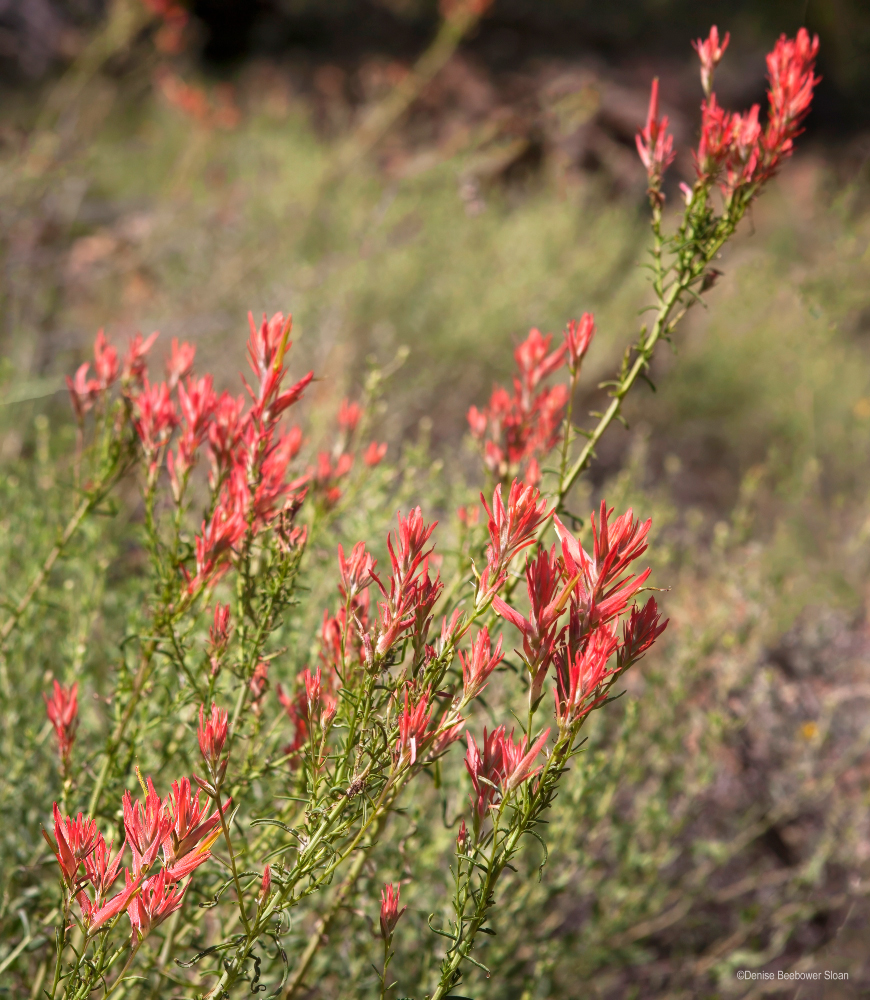
Denise Sloan/PCS Adventures
Indian paintbrush bloom profusely along the creek in Mule Canyon.
The south Mule Canyon hike is 4.4 miles round trip. But you only need to go 1.1 miles in to reach the House on Fire. The trail is relatively easy following a creek with just a small cliff scramble to reach the ruins.
Summer is broiling and winter can be very cold or mild depending upon the day. Plan accordingly.
The closest town is Blanding. We stayed there and drove out early one morning for our hike.

Denise Sloan/PCS Adventures