
Harpers Ferry National Historic Park
Denise Sloan
Kannan/Adobe Stock
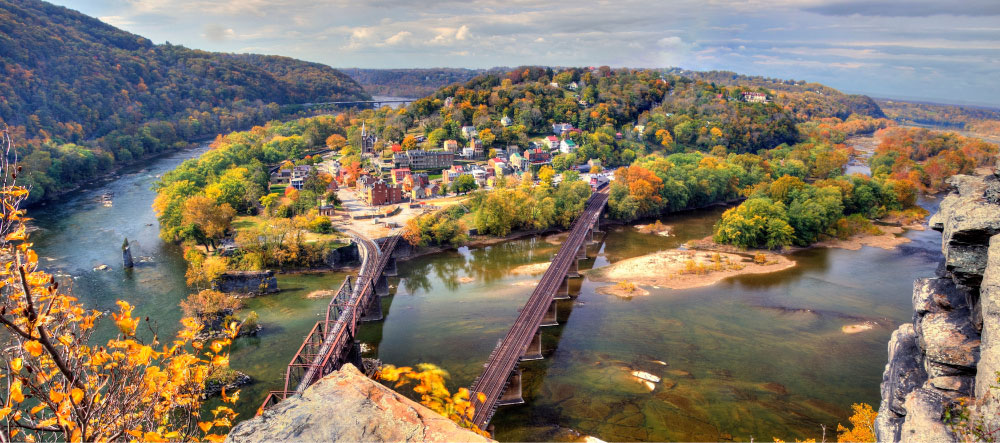
Harpers Ferry sits at the confluence of the Shenandoah and Potomac rivers.
Shortly after we moved to Ft. Meade, Maryland my friend Rebecca invited me on a day trip to Harpers Ferry National Historic Park in West Virginia. The only thing I knew about Harpers Ferry came from my parents’ stories about John Brown’s raid on the town.
My parents grew up in the same area where John Brown built a tannery with a secret room to hide escaping slaves. He was part of the Underground Railroad and an avid abolitionist.
But Harpers Ferry had a lot more going on than just John Brown. In fact, the town caught George Washington’s eye in the late 1790s.
From Canals to Battlefields
President Washington thought Harpers Ferry was the perfect site to construct two very important things our young nation needed, a national armory and a canal to ship goods to market. The Shenandoah and Potomac rivers met at the point where Harpers Ferry stood along with the borders of Maryland and Virginia. (Today that includes West Virginia, but back then Virginia hadn’t split into two states yet.)
Construction began and by 1801 the U.S. Armory and Arsenal located in Harpers Ferry manufactured most of America’s guns. They even supplied the Lewis and Clark Expedition.
Denise Sloan/PCS Adventures
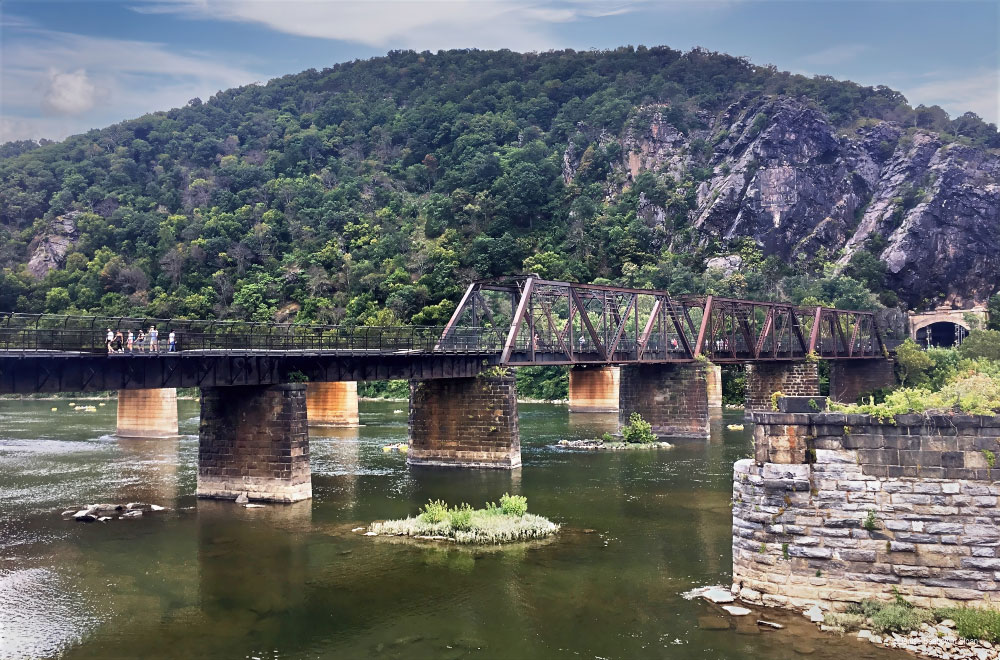
Visitors walk across the Potomac River from Harpers Ferry.
The Chesapeake & Ohio Canal construction started in 1828 and finished in 1850, running from Washington, D.C. to Cumberland, Maryland. Meanwhile in 1836 the Baltimore & Ohio Railroad came to Harpers Ferry. All of this industry and transportation set Harpers Ferry up to play a big role in the coming Civil War.
That’s where John Brown enters the story. In 1859 he planned a daring (some say crazy) raid on Harpers Ferry. His goal? Free all the slaves in the South. He and 19 men planned to take the U.S. Armory and Arsenal captive and give 10,000 guns to his supporters and slaves to force an end to slavery.
Denise Sloan/PCS Adventures
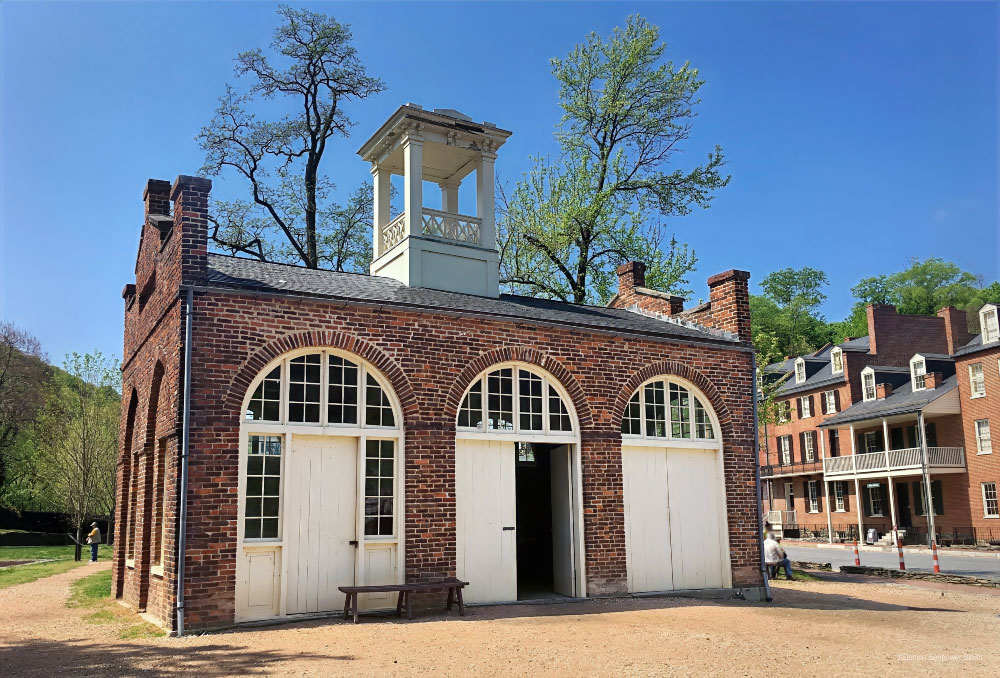
Brown & some of his men barracaded themselves in this building at the U.S. Armory & Arsenal.
Brown succeeded in capturing the armory and held it for 30 hours. Then U.S. troops under Colonel Robert E. Lee (later Confederate General Lee) killed, captured and defeated all of Brown’s men. Brown himself was wounded, captured and then put on trial. He was found guilty of treason and hanged.
In his last words, Brown said that a coming Civil War was the only way to end slavery in America. Just three years later, this bustling town along the rivers would become embroiled in the Battle of Harper’s Ferry.
Harpers Ferry and the Civil War
To understand the town’s role in the Civil War and to get around the park, you need to know a little geography. The town jutts out on a point surrounded on one side by the Shenandoah River and the other side by the Potomac River. Steep hillsides and cliffs look down on the town, creating perfect locations for military commanders to keep an advantage during a battle.
eqroy/Adobe Stock
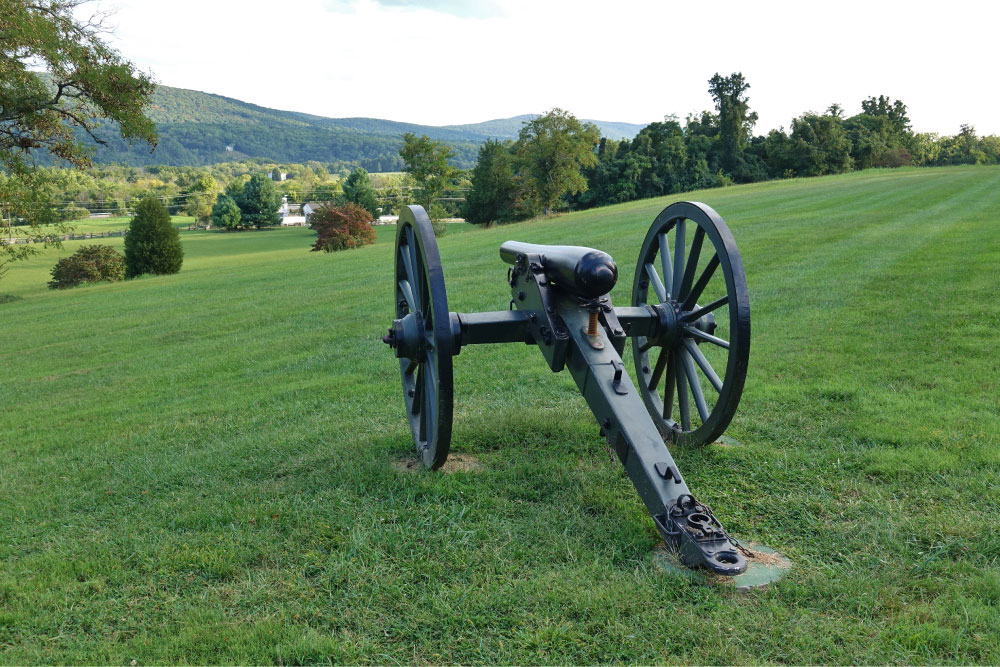
A cannon from the Civil War stands guard on Bolivar Heights.
Both the Union and the Confederacy wanted to control Harpers Ferry because of its transportation hub and armory. The weary town residents endured a virtual seesaw different armies taking control 14 times between 1861-1865!
Perhaps the most notable event took place during the Battle of Harpers Ferry. It lasted three days, September 12-15, 1862, and took place in five main areas: Bolivar Heights, School House Ridge North, School House Ridge South, Maryland Heights, and the Murphy-Chambers Farm.
Confederate General Lee sent three columns to capture Harpers Ferry from the Union. He put Stonewall Jackson in charge of the Confederates, resulting in the Union surrenduring an astonishing 12,500 soldiers.
Other Civil War related areas in the park include Camp Hill and Loudon Heights.
Taking It All In
Today touring Harpers Ferry brings decades of early American history to life. It includes a well-preserved town with a plethora of outdoor activities to enjoy. In addition to viewing the historical exhibits, visitors can go hiking, rock climbing, biking and fishing within the park.
I’d recommend starting at the visitors center on Shoreline Drive first. The large parking lot saves you time and frustration of hunting for limited parking in town. Plus you can get maps at the visitors center to plan your day. The shuttle bus comes through regularly, taking visitors to the far flung parts of the park.
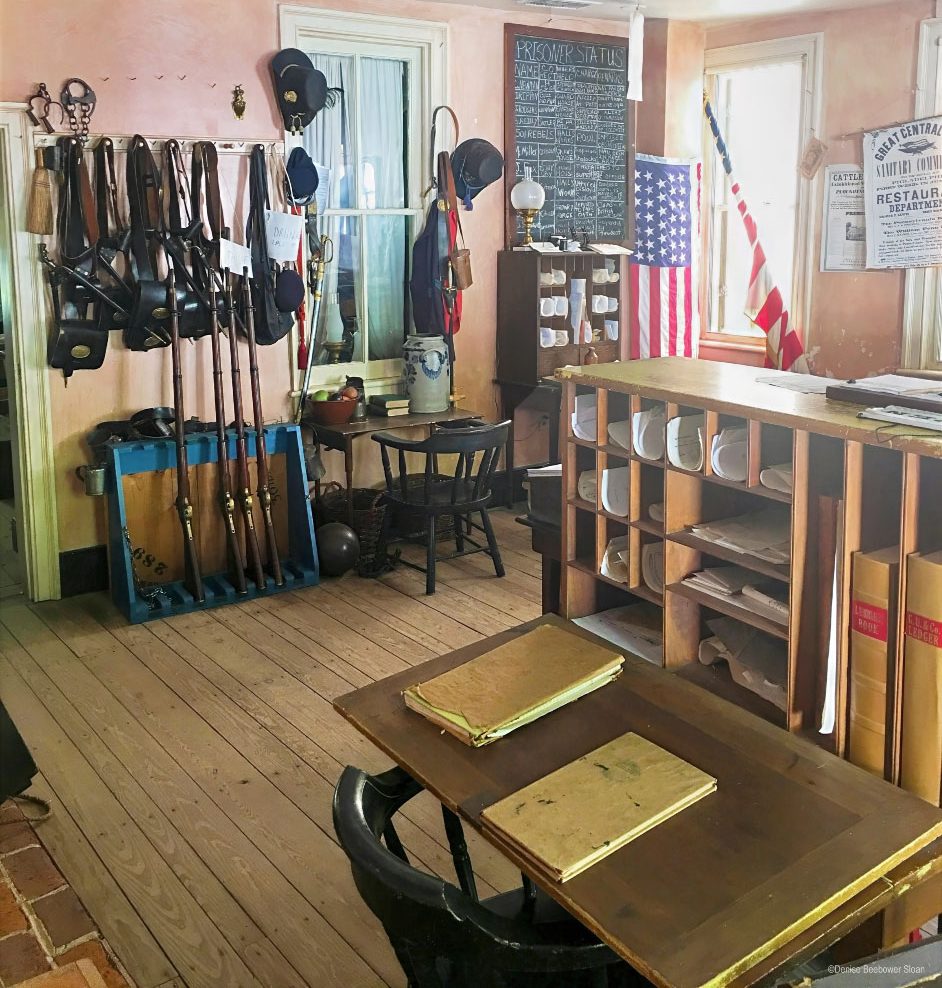
Denise Sloan/PCS Adventures
The Provost Marshall’s office depicts life in Harpers Ferry under martial law during 1864.
To see the battlefields, visit one of the seven areas I mentioned before. Choosing “Lower Town” takes you down to Harpers Ferry itself. It’s a little hard to tell where the historic parts ends and the town takes over, but all of it was enjoyable. Here you’ll find things like the Provost Marshall’s Office, a general store, John Brown’s Fort and museum, remains of the armory and access to the Appalachian Trail, the B & O rail tracks, Virginius and Halls islands plus the two rivers. There are numerous restaurants and shops to choose from in town too.
Expect to spend all day exploring this park if you’re a history buff. If you want to see all of the history and enjoy the outdoors, be ready to hike, bike or walk a lot.
After spending the day exploring Harpers Ferry with Rebecca, I knew I needed to bring my husband to the park. With so much U.S. and Army history from fascinating periods in our country, I knew he’d appreciate a day exploring Harpers Ferry. Plus I could share the “inside” scoop on old John Brown.
Closest Military Installations
MWR Locations Nearby
Joint Base Andrews, MD1 hour 40 minutes
Goose Creek Campground, MD 2 hours 40 minutes
If You Go:
- There is an entrance fee, but the America the Beautiful Pass (free for active duty, and retirees) covers this.
- Figure out where you want to go in the park before arriving. The park is spread out across West Virginia, Maryland and Virginia. Parking can be challenging. The visitors center has the largest lot and offers a shuttle bus to many areas in the park.
- Wear comfortable shoes. You’ll be walking quite a bit if you want to see everything.
- If you’re an avid national park stamp collector, visit the park’s bookstore in Lower Town Harpers Ferry to get your park passport stamps.